 Add to Chrome
 Add to Firefox
 Add to Edge
Talking Face Generation
Talking face generation is the process of generating videos of a person speaking based on an audio recording of their voice.
Papers and Code
EmoTaG: Emotion-Aware Talking Head Synthesis on Gaussian Splatting with Few-Shot Personalization
Mar 22, 2026
Audio-driven 3D talking head synthesis has advanced rapidly with Neural Radiance Fields (NeRF) and 3D Gaussian Splatting (3DGS). By leveraging rich pre-trained priors, few-shot methods enable instant personalization from just a few seconds of video. However, under expressive facial motion, existing few-shot approaches often suffer from geometric instability and audio-emotion mismatch, highlighting the need for more effective emotion-aware motion modeling. In this work, we present EmoTaG, a few-shot emotion-aware 3D talking head synthesis framework built on the Pretrain-and-Adapt paradigm. Our key insight is to reformulate motion prediction in a structured FLAME parameter space rather than directly deforming 3D Gaussians, thereby introducing explicit geometric priors that improve motion stability. Building upon this, we propose a Gated Residual Motion Network (GRMN), which captures emotional prosody from audio while supplementing head pose and upper-face cues absent from audio, enabling expressive and coherent motion generation. Extensive experiments demonstrate that EmoTaG achieves state-of-the-art performance in emotional expressiveness, lip synchronization, visual realism, and motion stability.

Face-to-Face: A Video Dataset for Multi-Person Interaction Modeling
Mar 16, 2026Modeling the reactive tempo of human conversation remains difficult because most audio-visual datasets portray isolated speakers delivering short monologues. We introduce \textbf{Face-to-Face with Jimmy Fallon (F2F-JF)}, a 70-hour, 14k-clip dataset of two-person talk-show exchanges that preserves the sequential dependency between a guest turn and the host's response. A semi-automatic pipeline combines multi-person tracking, speech diarization, and lightweight human verification to extract temporally aligned host/guest tracks with tight crops and metadata that are ready for downstream modeling. We showcase the dataset with a reactive, speech-driven digital avatar task in which the host video during $[t_1,t_2]$ is generated from their audio plus the guest's preceding video during $[t_0,t_1]$. Conditioning a MultiTalk-style diffusion model on this cross-person visual context yields small but consistent Emotion-FID and FVD gains while preserving lip-sync quality relative to an audio-only baseline. The dataset, preprocessing recipe, and baseline together provide an end-to-end blueprint for studying dyadic, sequential behavior, which we expand upon throughout the paper. Dataset and code will be made publicly available.
UniSync: Towards Generalizable and High-Fidelity Lip Synchronization for Challenging Scenarios
Mar 04, 2026Lip synchronization aims to generate realistic talking videos that match given audio, which is essential for high-quality video dubbing. However, current methods have fundamental drawbacks: mask-based approaches suffer from local color discrepancies, while mask-free methods struggle with global background texture misalignment. Furthermore, most methods struggle with diverse real-world scenarios such as stylized avatars, face occlusion, and extreme lighting conditions. In this paper, we propose UniSync, a unified framework designed for achieving high-fidelity lip synchronization in diverse scenarios. Specifically, UniSync uses a mask-free pose-anchored training strategy to keep head motion and eliminate synthesis color artifacts, while employing mask-based blending consistent inference to ensure structural precision and smooth blending. Notably, fine-tuning on compact but diverse videos empowers our model with exceptional domain adaptability, handling complex corner cases effectively. We also introduce the RealWorld-LipSync benchmark to evaluate models under real-world demands, which covers diverse application scenarios including both human faces and stylized avatars. Extensive experiments demonstrate that UniSync significantly outperforms state-of-the-art methods, advancing the field towards truly generalizable and production-ready lip synchronization.
LPIPS-AttnWav2Lip: Generic Audio-Driven lip synchronization for Talking Head Generation in the Wild
Jan 30, 2026Researchers have shown a growing interest in Audio-driven Talking Head Generation. The primary challenge in talking head generation is achieving audio-visual coherence between the lips and the audio, known as lip synchronization. This paper proposes a generic method, LPIPS-AttnWav2Lip, for reconstructing face images of any speaker based on audio. We used the U-Net architecture based on residual CBAM to better encode and fuse audio and visual modal information. Additionally, the semantic alignment module extends the receptive field of the generator network to obtain the spatial and channel information of the visual features efficiently; and match statistical information of visual features with audio latent vector to achieve the adjustment and injection of the audio content information to the visual information. To achieve exact lip synchronization and to generate realistic high-quality images, our approach adopts LPIPS Loss, which simulates human judgment of image quality and reduces instability possibility during the training process. The proposed method achieves outstanding performance in terms of lip synchronization accuracy and visual quality as demonstrated by subjective and objective evaluation results. The code for the paper is available at the following link: https://github.com/FelixChan9527/LPIPS-AttnWav2Lip
* This paper has been accepted by Elsevier's \textit{Speech Communication} journal. Official publication link: https://doi.org/10.1016/j.specom.2023.103028 The code for the paper is available at the following link: https://github.com/FelixChan9527/LPIPS-AttnWav2Lip
MIRRORTALK: Forging Personalized Avatars Via Disentangled Style and Hierarchical Motion Control
Jan 30, 2026Synthesizing personalized talking faces that uphold and highlight a speaker's unique style while maintaining lip-sync accuracy remains a significant challenge. A primary limitation of existing approaches is the intrinsic confounding of speaker-specific talking style and semantic content within facial motions, which prevents the faithful transfer of a speaker's unique persona to arbitrary speech. In this paper, we propose MirrorTalk, a generative framework based on a conditional diffusion model, combined with a Semantically-Disentangled Style Encoder (SDSE) that can distill pure style representations from a brief reference video. To effectively utilize this representation, we further introduce a hierarchical modulation strategy within the diffusion process. This mechanism guides the synthesis by dynamically balancing the contributions of audio and style features across distinct facial regions, ensuring both precise lip-sync accuracy and expressive full-face dynamics. Extensive experiments demonstrate that MirrorTalk achieves significant improvements over state-of-the-art methods in terms of lip-sync accuracy and personalization preservation.
From Blurry to Believable: Enhancing Low-quality Talking Heads with 3D Generative Priors
Feb 05, 2026Creating high-fidelity, animatable 3D talking heads is crucial for immersive applications, yet often hindered by the prevalence of low-quality image or video sources, which yield poor 3D reconstructions. In this paper, we introduce SuperHead, a novel framework for enhancing low-resolution, animatable 3D head avatars. The core challenge lies in synthesizing high-quality geometry and textures, while ensuring both 3D and temporal consistency during animation and preserving subject identity. Despite recent progress in image, video and 3D-based super-resolution (SR), existing SR techniques are ill-equipped to handle dynamic 3D inputs. To address this, SuperHead leverages the rich priors from pre-trained 3D generative models via a novel dynamics-aware 3D inversion scheme. This process optimizes the latent representation of the generative model to produce a super-resolved 3D Gaussian Splatting (3DGS) head model, which is subsequently rigged to an underlying parametric head model (e.g., FLAME) for animation. The inversion is jointly supervised using a sparse collection of upscaled 2D face renderings and corresponding depth maps, captured from diverse facial expressions and camera viewpoints, to ensure realism under dynamic facial motions. Experiments demonstrate that SuperHead generates avatars with fine-grained facial details under dynamic motions, significantly outperforming baseline methods in visual quality.
RSATalker: Realistic Socially-Aware Talking Head Generation for Multi-Turn Conversation
Jan 15, 2026Talking head generation is increasingly important in virtual reality (VR), especially for social scenarios involving multi-turn conversation. Existing approaches face notable limitations: mesh-based 3D methods can model dual-person dialogue but lack realistic textures, while large-model-based 2D methods produce natural appearances but incur prohibitive computational costs. Recently, 3D Gaussian Splatting (3DGS) based methods achieve efficient and realistic rendering but remain speaker-only and ignore social relationships. We introduce RSATalker, the first framework that leverages 3DGS for realistic and socially-aware talking head generation with support for multi-turn conversation. Our method first drives mesh-based 3D facial motion from speech, then binds 3D Gaussians to mesh facets to render high-fidelity 2D avatar videos. To capture interpersonal dynamics, we propose a socially-aware module that encodes social relationships, including blood and non-blood as well as equal and unequal, into high-level embeddings through a learnable query mechanism. We design a three-stage training paradigm and construct the RSATalker dataset with speech-mesh-image triplets annotated with social relationships. Extensive experiments demonstrate that RSATalker achieves state-of-the-art performance in both realism and social awareness. The code and dataset will be released.
Efficient and Robust Video Defense Framework against 3D-field Personalized Talking Face
Dec 24, 2025State-of-the-art 3D-field video-referenced Talking Face Generation (TFG) methods synthesize high-fidelity personalized talking-face videos in real time by modeling 3D geometry and appearance from reference portrait video. This capability raises significant privacy concerns regarding malicious misuse of personal portraits. However, no efficient defense framework exists to protect such videos against 3D-field TFG methods. While image-based defenses could apply per-frame 2D perturbations, they incur prohibitive computational costs, severe video quality degradation, failing to disrupt 3D information for video protection. To address this, we propose a novel and efficient video defense framework against 3D-field TFG methods, which protects portrait video by perturbing the 3D information acquisition process while maintain high-fidelity video quality. Specifically, our method introduces: (1) a similarity-guided parameter sharing mechanism for computational efficiency, and (2) a multi-scale dual-domain attention module to jointly optimize spatial-frequency perturbations. Extensive experiments demonstrate that our proposed framework exhibits strong defense capability and achieves a 47x acceleration over the fastest baseline while maintaining high fidelity. Moreover, it remains robust against scaling operations and state-of-the-art purification attacks, and the effectiveness of our design choices is further validated through ablation studies. Our project is available at https://github.com/Richen7418/VDF.
FacEDiT: Unified Talking Face Editing and Generation via Facial Motion Infilling
Dec 16, 2025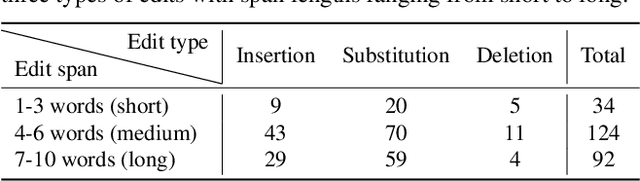
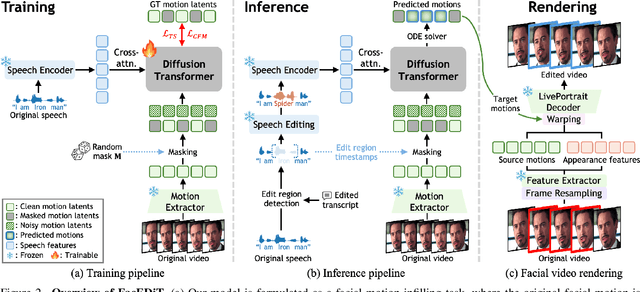

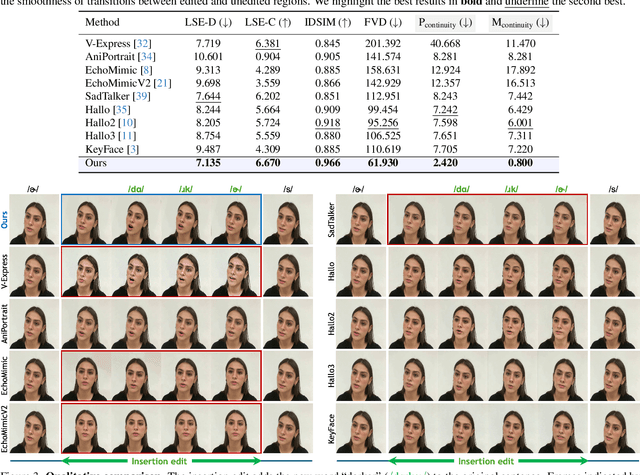
Talking face editing and face generation have often been studied as distinct problems. In this work, we propose viewing both not as separate tasks but as subtasks of a unifying formulation, speech-conditional facial motion infilling. We explore facial motion infilling as a self-supervised pretext task that also serves as a unifying formulation of dynamic talking face synthesis. To instantiate this idea, we propose FacEDiT, a speech-conditional Diffusion Transformer trained with flow matching. Inspired by masked autoencoders, FacEDiT learns to synthesize masked facial motions conditioned on surrounding motions and speech. This formulation enables both localized generation and edits, such as substitution, insertion, and deletion, while ensuring seamless transitions with unedited regions. In addition, biased attention and temporal smoothness constraints enhance boundary continuity and lip synchronization. To address the lack of a standard editing benchmark, we introduce FacEDiTBench, the first dataset for talking face editing, featuring diverse edit types and lengths, along with new evaluation metrics. Extensive experiments validate that talking face editing and generation emerge as subtasks of speech-conditional motion infilling; FacEDiT produces accurate, speech-aligned facial edits with strong identity preservation and smooth visual continuity while generalizing effectively to talking face generation.
Generalizable and Animatable 3D Full-Head Gaussian Avatar from a Single Image
Jan 19, 2026Building 3D animatable head avatars from a single image is an important yet challenging problem. Existing methods generally collapse under large camera pose variations, compromising the realism of 3D avatars. In this work, we propose a new framework to tackle the novel setting of one-shot 3D full-head animatable avatar reconstruction in a single feed-forward pass, enabling real-time animation and simultaneous 360$^\circ$ rendering views. To facilitate efficient animation control, we model 3D head avatars with Gaussian primitives embedded on the surface of a parametric face model within the UV space. To obtain knowledge of full-head geometry and textures, we leverage rich 3D full-head priors within a pretrained 3D generative adversarial network (GAN) for global full-head feature extraction and multi-view supervision. To increase the fidelity of the 3D reconstruction of the input image, we take advantage of the symmetric nature of the UV space and human faces to fuse local fine-grained input image features with the global full-head textures. Extensive experiments demonstrate the effectiveness of our method, achieving high-quality 3D full-head modeling as well as real-time animation, thereby improving the realism of 3D talking avatars.